Comparing the lifetime electricity value of a container ship of PV modules against a supertanker of crude oil and an LNG carrier.
VLCC supertanker of crude oil: ~1.1 TWh
Large LNG carrier: ~0.57 TWh
1 ship of panels ≈ 105 supertankers of oil
1 ship of panels ≈ 203 LNG carriers
Container Ship of Solar Panels

| Assumption | Value |
|---|---|
| Ship size | 20,000 TEU |
| 40-ft containers | 10,000 |
| Panels per 40-ft container (550W, ~25 kg each) | ~600 |
| Capacity per container | 330 kW |
| Total ship capacity | 3.3 GW |
| Mid-US annual insolation (capacity factor ~17%) | 1,500 kWh/kWp/yr |
| Year-1 production | ~4.95 TWh |
| Degradation rate | 0.5%/yr |
| 25-year average degradation factor | ~0.94x |
| 25-year lifetime electricity | ~116 TWh |
VLCC Supertanker of Crude Oil
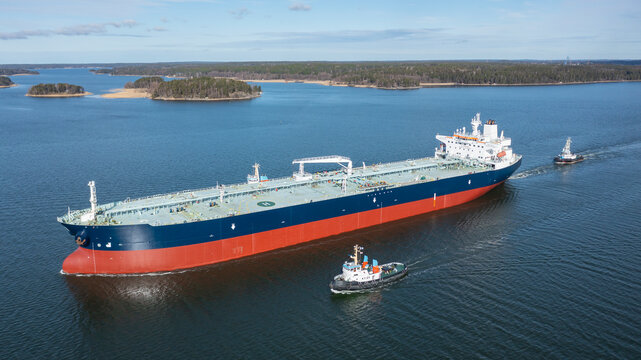
| Assumption | Value |
|---|---|
| Cargo capacity | 2,000,000 bbl |
| Energy content of crude | ~1,700 kWh/bbl |
| Total thermal energy | 3.4 TWh |
| Steam turbine efficiency (oil-fired power plant) | ~33% |
| Electricity produced | ~1.1 TWh |
Large LNG Carrier
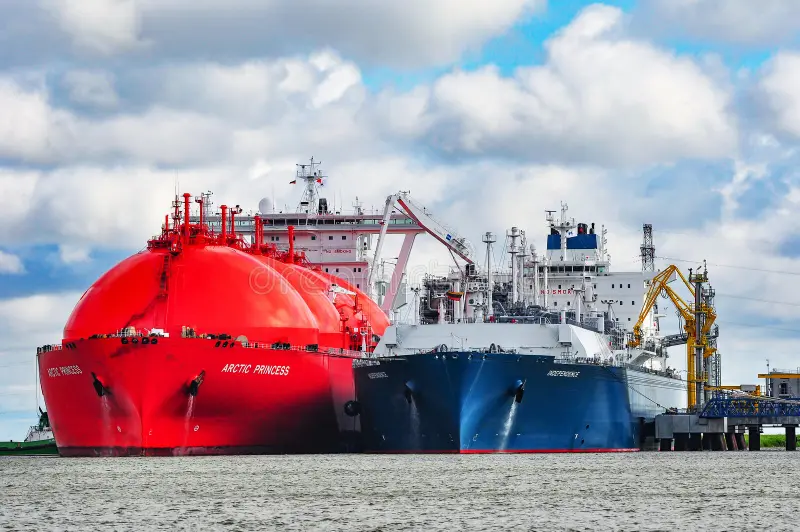
| Assumption | Value |
|---|---|
| Cargo capacity | 170,000 m3 LNG |
| LNG density | ~0.45 tonnes/m3 |
| Mass | ~76,500 tonnes |
| Energy content of natural gas | ~13.9 kWh/kg |
| Total thermal energy | ~1.06 TWh |
| Combined-cycle gas turbine efficiency | ~55% |
| Regasification losses | ~2% |
| Electricity produced | ~0.57 TWh |
Note on Geography
This analysis uses mid-range assumptions throughout. Sunnier locations (Southwest US) would push solar output ~30% higher. The container count is conservative; modern ultra-large container vessels exceed 24,000 TEU. We also ignore the energy cost of extracting, refining, and transporting fossil fuels, which would widen the gap further.
Sources: Ship capacities based on standard VLCC (320,000 DWT), large LNG carrier (170,000 m3), and 20,000 TEU container vessel specs. Panel specs based on current-generation 550W bifacial modules (~25 kg, ~2.4 m2). Mid-US insolation from NREL PVWatts Calculator for Kansas City, MO (fixed-tilt south-facing). Degradation per industry-standard 0.5%/yr linear assumption. Conversion efficiencies from EIA data on US fleet-average heat rates.